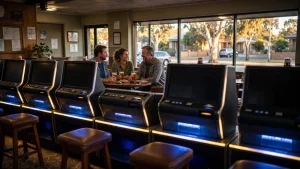
The guide explains the legal gap, live and RNG formats, table conditions, payments and the rules behind each outcome.
The phrase “live baccarat online casino Australia 2026” describes a market that exists in practice but has no domestic online-casino licensing system. Australia has locally licensed gambling businesses, yet those licences do not authorise online casino games. The distinction matters: a licence for another form of gambling is not a local permit to offer baccarat over the internet.
The governing line is drawn by the Interactive Gambling Act 2001. It prohibits operators from providing real-money online casino games to people in Australia, including table games such as baccarat. The restriction falls on the service provider, not on the person who happens to play. There are no locally licensed online casinos officially operating in Australia.
That leaves a gap between the legal framework and the habits of some Australians. People do play baccarat online through international casino platforms that accept Australian customers. Their presence does not turn those platforms into Australian-licensed casinos, nor does the fact that a site can be reached establish that its service is lawful to provide here. A familiar logo, an Australian-facing page or a payment option in local currency cannot supply a domestic licence where none exists.
The difference is easy to blur in the language of the internet. A platform may call itself a casino, present baccarat in a polished lobby and accept registrations from Australians. Those details describe how the business presents itself; they do not alter the Australian rule. A foreign licence, where a platform holds one, is not a licence issued under Australian law to provide online casino games to people in Australia.
This is not a small-print distinction. The law places the obligation on operators, and online casino services are actively restricted and enforced against in Australia. Access may be blocked. At the same time, international platforms have continued to attract Australian players, creating a practical landscape that does not neatly match the official one. Participation occurs; local authorisation does not follow.
The market therefore has two separate descriptions. In law, real-money online baccarat cannot be offered by an Australian-licensed operator, and no locally licensed online casino officially fills that role. In everyday practice, some Australians seek out international sites that accept them. Treating the second description as proof of the first would confuse availability with permission. The internet is very good at making that confusion look ordinary.
For people in Australia, the legal risk described by the framework belongs to the operator providing the prohibited service; players do not face a fine or criminal prosecution simply for playing at an offshore casino without a local licence. That does not make the arrangement equivalent to using a locally regulated casino. It means the legal responsibility is not symmetrical. A customer may encounter a service operating outside the domestic licensing framework, while the protections and routes for complaint associated with local regulation are not thereby created.
This context is specific to online casino gambling. It should not be folded into a general statement that all gambling is prohibited in Australia: the law distinguishes online casino services from other forms of gambling. But baccarat offered for real money through an online casino falls on the prohibited side of that boundary when the customer is physically in Australia. The table’s digital location, the company’s overseas address and the currency displayed do not change where the player is located.
Legal Status
Real-money online casino games are prohibited in Australia under the Interactive Gambling Act 2001, and operators providing such services face active enforcement and blocking.
There is also a social explanation for why the distinction can be hard to see. Online services borrow the familiar surface of a casino: a lobby, a table, a dealer’s image, a button to join. The interface makes distance feel like a technical detail. Regulation insists that it is not. A service can appear immediate and local while remaining an offshore operation outside Australia’s licensing structure.
Information about the market is not an invitation to use an offshore casino, and describing the existence of international platforms should not be mistaken for endorsing them. Gambling can cause financial harm, and Freshbetguide-au.com is not liable for losses arising from gambling. This material is intended for adults aged 18 and over. If gambling is causing harm, seeking support is more important than finding another table.
In Australia, then, “online baccarat” names a real pattern of behaviour, not a locally licensed casino sector. The law and the market do not meet in the tidy way a search result might suggest. The distinction is the point.
Choosing a live baccarat casino in Australia means weighing the details that are actually available before deciding where to play. This list provides a concise reference to the stated licensing, deposit and payout information for each operator.
JustCasino
JustCasino is listed with a Curacao Gaming Control Board license. That is the licensing detail provided for this operator.
Neospin
Neospin is listed under Curacao Gaming Control Board license OGL/2023/176/0095, with Hollycorn N.V. named in connection with it.
Thor Casino
Thor Casino is listed with a Curacao license through Antillephone N.V. (Versus Odds B.V.). Its stated minimum deposit is EUR 20.
MrPacho
MrPacho lists a minimum deposit of A$30. Its stated payout times are 30–120 minutes for crypto and 24–72 hours for fiat.
JeetCity Casino
JeetCity Casino is listed with a Curacao eGaming license, with Dama N.V. named as the license holder.
DragonSlots Casino
DragonSlots Casino is listed with a Curacao Gaming Authority license, with Jumpman Gaming Ltd named in connection with it.
Uptown Pokies
Uptown Pokies is listed as operating under a Curacao license since 2017. Its stated minimum deposit is A$20.
Playfina Casino
Playfina Casino is listed with a Curacao eGaming license through Hollycorn N.V. and has been operating since 2017. The stated minimum deposit is A$20–30, depending on the offer.
Ricky Casino
Ricky Casino lists a minimum deposit of A$20, or A$30 to qualify for the bonus. Its stated payout times are under an hour for crypto and 1–3 business days for PayID.
WinSpirit Casino
WinSpirit Casino is listed under Curacao eGaming license OGL/2024/923/0383, with Antillephone N.V. named in connection with it. Its stated minimum deposit is A$30.
A useful comparison of baccarat platforms would need to measure something more substantial than a polished lobby. Yet a ranking can imply that the names have been independently tested and that the resulting order is meaningful. Without a sound basis for that claim, a list of “best” casinos is decoration with numbers attached.
For Australian readers, there is a more fundamental qualification: real-money online casino games cannot lawfully be provided to people in Australia by operators under the Interactive Gambling Act 2001. Offshore services may be presented online, but they are not locally licensed alternatives, and access is subject to active blocking and enforcement. Any discussion of how such services are evaluated is descriptive, not an endorsement or an invitation to use them.
Withdrawal terms reveal more than a banner announcing easy cash-outs. The published maximum matters, but so do the period to which it applies, any distinction between account levels, and the conditions for a payment to be processed. A cap can make a large balance difficult to move even when the stated payment method appears straightforward. The number on a page is only one part of the arrangement.
One specialist review reports weekly withdrawal caps of $5,000–$10,000 at offshore sites. That is a reported range from a single review, not a dependable market standard or a guarantee about any particular service. Limits can differ, change, or be described in terms that require careful reading. The useful question is not whether a headline amount sounds generous, but what the written terms actually permit and how clearly they explain it.
This distinction matters because a platform’s table can make money feel immediate while its payment rules remain remote and conditional. The interface belongs to the present tense; withdrawal clauses tend to belong to fine print.
The scale of available bets is another comparison point, though a larger ceiling is not evidence of quality. A low entry stake and a high maximum serve different budgets and different appetites for risk. The important feature is whether the stated range is transparent, rather than whether its upper end looks impressive.
A specialist review reports that VIP baccarat at some casinos may have limits as high as A$20,000 per bet. This is an upper-end report, not a typical table limit and not a reason to treat high-stakes access as a mark of merit. “VIP” is a label, not an independent assessment. A high ceiling can be relevant to a narrow group of players; for everyone else, it may be little more than theatre.
A sensible comparison would therefore keep the minimum and maximum in view together. A platform with a conspicuous top limit but unclear ordinary table conditions tells only half its story. Equally, a modest ceiling is not automatically a defect. Limits describe the boundaries of play, not the fairness or suitability of a service.
Descriptions such as “premium,” “exclusive” and “high limit” are easy to publish and difficult to verify. More useful material is specific: written withdrawal rules, clearly stated betting boundaries, and terms that do not shift the meaning of familiar words between the lobby and the cashier. A comparison should distinguish what is explicitly stated from what is inferred.
No single feature can settle the question of which online baccarat casino is “best.” A payment cap says something about access to funds; a table limit says something about the scale of a wager. Neither, by itself, proves that a service is reliable, lawful for Australian customers, or appropriate for anyone’s circumstances. Ranking names without comparable, current evidence would turn uncertainty into a false precision.
That is the whole trick.
This section is informational, not a recommendation to use an offshore casino. Gambling can cause financial harm, and Freshbetguide-au.com accepts no liability for gambling losses. 18+ only. If gambling is causing harm, stop and seek support.
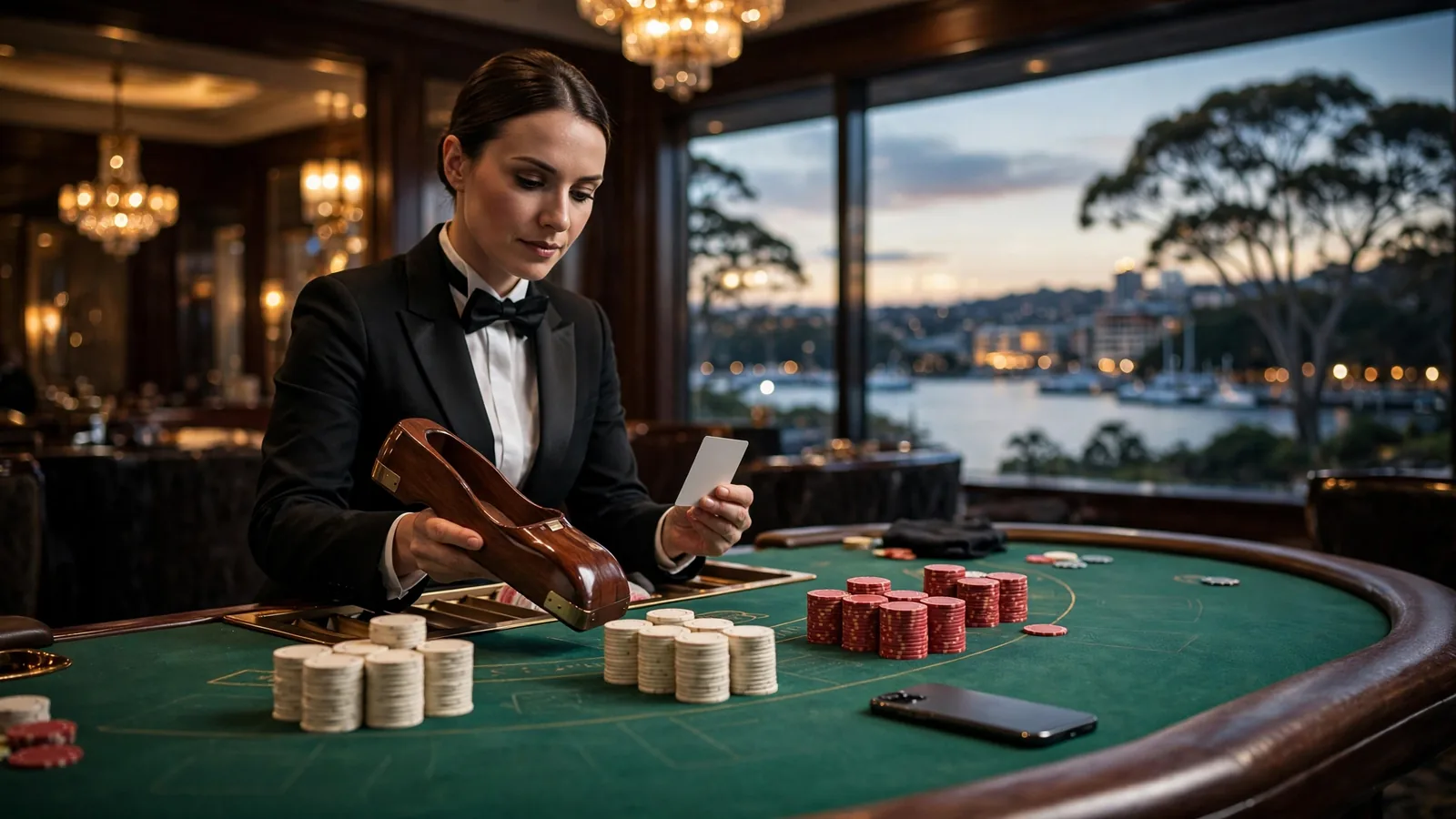
Live dealer baccarat places a studio performance inside a digital frame. A professional dealer sits at a physical table, handles real cards and conducts the game while a camera stream carries the scene to a virtual table. The screen is not merely a picture laid over software: the cards and the person dealing them are present in the studio, even when the participants are scattered elsewhere.
That distinction gives the format its particular atmosphere. A shuffle, a pause, the dealer’s gestures and the movement of cards supply a visible sequence that can be followed as it happens. The camera makes the table legible, while the dealer’s steady rhythm gives the broadcast a human centre. It is a small piece of theatre, though the stage is designed to keep attention on the felt.
The studio has its own conventions. The dealer addresses the camera, handles the cards and prompts betting in real time; the stream keeps those actions in view rather than presenting only a completed result. The virtual table is therefore both a place to take part and a viewing window onto a carefully arranged set. There is a real person in the frame, but the exchange remains mediated by screens, cameras and the platform’s interface.
That mediation matters. The dealer may be visible, but the broadcast is not the same as being seated across the table. The camera chooses the view, the interface organises participation, and the room beyond the shot stays out of sight. Online baccarat with a live dealer borrows the ceremony of a casino table without reproducing the whole social world around one. No clink of glasses. No crowd leaning in. Just the scene the camera has been set to show.
Chat can add another layer. A specialist review reports that some live baccarat games allow players to message the dealer or other participants, though the feature depends on the particular table. When available, it lends the broadcast a faint communal quality: a greeting or brief comment can travel across the interface while the cards remain the focus. It is not quite conversation in a shared room. The dealer is working, the messages arrive in a separate channel, and the camera continues its composed account of the table.
Some live baccarat games include a chat feature allowing players to message the dealer or other participants, depending on the specific table.
The contrast between physical cards and a digital audience is part of the format’s appeal, but it should not be mistaken for a guarantee about fairness or safety. A visible deal describes how the game is presented; it does not establish the legal status of the service or remove the financial risks of gambling. In Australia, real-money online casino games are prohibited services under the Interactive Gambling Act 2001, and the presence of a studio stream does not change that. Gambling can cause financial harm. The website accepts no liability for losses.
The studio’s polish is deliberate: lighting, camera angles and a measured pace turn a card table into a broadcast. That polish can make the event feel intimate, although intimacy is not the same as company. The dealer performs for a camera, and the audience meets through an interface. A table, carefully framed.
The same baccarat rules can sit behind two quite different experiences. International platforms offer live dealer baccarat, in which a streamed table presents a dealer and physical cards, and RNG baccarat, where algorithm-based software determines the outcomes. The distinction is not merely visual. It changes what players watch and how quickly one hand gives way to the next.
In the live format, the cards are dealt at a physical table and the action is transmitted as it happens. The sequence has a human rhythm: a dealer carries out each stage, while the software handles the stream and betting interface. A pause is part of the visible event, not an animation concealing a calculation. The table has a social surface, too, even when participation consists mainly of watching.
RNG baccarat removes that physical performance. Its results come from software rather than cards dealt in front of a camera. The interface may reproduce the familiar table layout, but the apparent setting is not the source of the result. For anyone comparing baccarat casino games, that is the essential difference: one format shows a live deal; the other generates outcomes through an algorithm.
Neither format changes the central proposition of baccarat. The familiar sides remain, and the hand nearest to nine takes the round. But the way a game presents that proposition can shape its tempo. A live table’s pace depends on the dealing process and the time allowed for betting. RNG baccarat can move through its interface without waiting for a dealer to handle cards, though the precise pace depends on the game’s design.
Speed tables make the contrast especially visible. A specialist review gives a reported rate of roughly 40–50 hands per hour for standard live baccarat and more than 80 for Speed tables. Those are figures from one review, not a fixed promise about every table: presentation, pauses and operator settings can affect the rate. Still, the comparison captures the broad difference between a measured deal and a deliberately accelerated one.
The faster rhythm is not a strategic advantage in itself. It means less time between rounds and more frequent occasions to make a decision. A slower table leaves more room to follow each deal; a faster one compresses the interval. The distinction is about pace, not a change in the underlying game rules or an improved chance of winning.
That is where interface design quietly becomes part of the game. In a live table, the dealer’s movements make time legible: the round is unfolding in view. In RNG baccarat, the result arrives through the software’s presentation, and the transition to another hand may feel more immediate. The first borrows the cadence of a casino table; the second belongs to the quicker logic of a digital game.
Features a streamed physical table with a professional dealer and real cards, following a human rhythm.
Uses algorithm-based software to determine outcomes, offering a faster pace without a physical deal.
An accelerated version of live baccarat, reported to provide significantly more hands per hour than standard tables.
Neither should be confused with a different set of baccarat rules. They are two ways of delivering the same broad game, with different sources of outcome and different rhythms. One puts a human deal on screen; the other relies on software. The pace, however, is no small detail. It determines how much of the experience is watching and how much is moving on.
A live dealer baccarat hand begins with a choice on the virtual table: Banker, Player or Tie. The two hands are then compared, and the one nearest to nine wins. That is the practical shape of the decision, even when the room around it is digital and the cards are dealt elsewhere. The table layout puts the betting options within reach before the deal; the player’s role is to select a wager and watch the hand unfold.
The pace gives that simple choice a particular weight. A live stream has a betting window, then a deal, then a result. There is less room for leisurely reconsideration once the table closes betting. The action is not controlled by tapping cards or directing the dealer; the game proceeds according to its table procedure. The player observes and chooses a side. A small ritual, made of waiting.
This is one reason that the phrase “how to play” can sound more elaborate than the activity itself. The central choice is visible on the screen, while the rules governing the cards operate in the background. The interface may show recent outcomes or a score display, but those records do not change the next hand. The attraction of live dealer baccarat lies partly in having a visible human deal, yet the player remains a spectator to the dealing and an actor only at the betting stage.
On a phone, the same arrangement is compressed into a smaller frame. A specialist review reports that live baccarat can be accessed on Android and iOS devices. The mobile version still depends on a streamed table, so the useful questions are practical: whether the table controls remain legible, whether the betting options are easy to distinguish, and whether the stream can be followed without interruption. A handheld screen changes the setting, not the structure of the wager.
There is also a material difference between watching a demonstration and joining a live table. A specialist review describes live dealer games as often being offered only for real money, which means access may require a real-money balance rather than a free-play mode. That distinction matters before the first bet: a live table is not automatically a practice room simply because it appears in a casino lobby. The entertainment is attached to a financial decision.
The expression “play baccarat online” can therefore conceal two separate acts: following a streamed hand and staking money on its outcome. The first is observation; the second carries financial risk. A display of cards, chips and dealer gestures can make the latter feel like a social pastime, but the interface does not soften the possibility of loss. No website can be liable for gambling losses.
This account is for adults aged 18 and over. Gambling can cause financial harm; participation should not be treated as a way to make money, and anyone affected by gambling should seek appropriate support. A phone makes the table portable. It does not make the consequences weightless.
A live table is not simply an image waiting to be opened. It has a place, a schedule and a minimum stake, all set by the service that runs it. Those practical conditions matter before any question of preference arises. In Australia, however, real-money online casino games are prohibited services under the Interactive Gambling Act 2001, and access to offshore services is actively blocked and enforced. A description of table conditions is not an invitation to use them.
The minimum stake can make a table inaccessible even when it appears in a lobby. A specialist review reports live baccarat minimums in the $5–$10-per-hand range, while $1 tables are uncommon. These figures describe a changing market, not a dependable standard: limits can differ between tables and may change. The practical distinction is plain enough. A low-stake label cannot be assumed to mean a low-cost session, and the stake shown before joining is more informative than the table’s name.
Time is another condition that can be easy to overlook. A live table may operate within a schedule or impose time restrictions, rather than remaining available at every hour. A specialist review advises checking the relevant schedule; that is a detail of the service, not a universal timetable. Live play depends on a staffed table and its operating arrangements. A listed table and an open seat are not the same thing.
Practice access has its own limits. A specialist review describes trial play as possible but constrained by the finite number of seats at live tables. Unlike software that can reproduce a solitary practice round on demand, a streamed table has a dealer and a set of places for participants. Trial access, where offered, therefore cannot be treated as an assured or continuous option. The distinction is structural, not a matter of anyone being especially generous.
The useful facts about a table are consequently modest: the stated minimum, whether the table is scheduled, and whether trial access is actually available. None promises a seat or makes a prohibited service lawful in Australia. For people aged 18 and over, gambling carries a risk of financial loss; Freshbetguide-au.com is not liable for losses. Responsible gambling means recognising that risk and not treating play as a way to make money.
Money has its own geography. A balance displayed in Australian dollars may look straightforward, while an account held in US dollars or euros can carry a less visible cost when funds are converted. An AUD-denominated wallet avoids the stated conversion margin of 2.5–4% applied to USD or EUR balances. The difference is not a baccarat rule; it is a charge attached to the route money takes.
Payment options reported in Australian market coverage include PayID, bank transfers, Visa and Mastercard, e-wallets and cryptocurrency. That list describes methods discussed in the market, not a promise that every method is available or lawful for every service. In particular, credit card payments must not be accepted for online gambling services in Australia. A payment logo, where one appears, does not settle what kind of transaction it permits.
Attention Credit card payments must not be accepted for online gambling services in Australia.
Crypto gives the question a different vocabulary, not a different arithmetic. Bitcoin may be named among payment methods, but a balance held in a cryptocurrency is not the same as an AUD balance. Its value can move, and converting between currencies or assets may add costs beyond the visible amount sent. The word “Bitcoin” can lend a transaction an air of modern simplicity. The ledger remains stubbornly practical.
Bonuses bring another accounting distinction. A baccarat casino bonus is not simply extra cash with no conditions attached: wagering terms can specify which games count, and how much they contribute toward the requirement. A specialist review reports live baccarat contribution in the range of 5–15%; that is a reported figure, not a dependable rule across services. The terms attached to a particular offer determine the actual treatment.
A high headline bonus can therefore have little bearing on the funds available for baccarat if the game contributes only a small share, or is excluded. The relevant wording is usually in the promotion’s terms, where eligible games, contribution rates and withdrawal conditions are set out. A bonus balance and a withdrawable balance may also be treated differently. Reading those distinctions is less glamorous than watching a table, but more consequential to the account.
This is general information, not an invitation to use an online casino. Gambling can cause financial harm; Freshbetguide-au.com is not liable for any losses. This material is for adults aged 18 and over. Anyone experiencing harm from gambling should seek support.
A baccarat scoreboard turns each hand into a compact record: the cards dealt, the resulting total and the side recorded as the winner. Its arithmetic is deliberately spare. Picture cards count as zero; when a hand’s card values add to more than ten, the left-hand digit is discarded. The remainder is the total shown. A high sum is not necessarily a high score.
That small operation matters because the display is not showing an ordinary cumulative total. It is reducing the cards to a single-digit result, with the hand nearest nine taking the advantage. The scoreboard makes that result visible, but it does not explain the cost of the wager placed beside it. Those are separate pieces of information, often crowded into the same interface.
The house edge gives one way to compare that cost over the long run. In live baccarat, the Banker bet has a house edge of 1.06%, while the Player bet stands at 1.24%. The difference is narrow, but it is not a visual distinction on the table: both selections may look equally simple on screen. The Tie bet is a different proposition, with a 14.36% house edge. Its larger potential attraction does not erase that higher mathematical cost.
These figures describe the statistical structure of the bets, not the outcome of any particular hand. A scoreboard records what has happened; it does not make the next result more predictable. Streaks and patterns can be easy to read into a sequence of totals, but the display is a record, not a forecast. A neat grid is not an oracle.
For anyone examining casino baccarat material, the useful distinction is between the arithmetic of the cards and the pricing of the bets. The first explains how a displayed total is formed. The second describes the built-in advantage held by the game over repeated play. Neither turns an individual result into a certainty.
18+ only. Gambling carries a risk of financial loss. Freshbetguide-au.com is not liable for losses arising from gambling. This material is informational and is not an offer of online casino services in Australia.
A baccarat tile in a casino lobby identifies a game category, not a single way to play. International platforms may place live dealer baccarat and RNG baccarat side by side. The first connects play to a live table; the second runs through software. Their shared name can make them look interchangeable in a menu, but the lobby is only an index. It does not tell the whole story of access.
Nor does a baccarat listing mean that every version is available for trial. A specialist review notes that trial access to live tables can be limited because only a finite number of players can occupy a table. That practical constraint is different from the presence of a game in a catalogue: a tile can remain visible when there is no trial seat to take. A menu is not a chair.
“Mini baccarat” may also appear as a label, but a name in a lobby alone does not settle what access is offered or whether a live table can be entered without wagering. The relevant distinction is between the game being listed and a seat being available under the conditions shown. Trial play, where offered, is not necessarily a route into every live table.
This is why “baccarat casino” can describe quite different things: a software game, a live stream, or merely a category containing both. The lobby’s neat rows disguise a less neat arrangement of formats and access. A listing is a label, not an invitation.
In Australia, that distinction sits within a wider legal boundary: the Interactive Gambling Act 2001 prohibits operators from providing real-money online casino games to people in the country. This description does not offer or promote access to such services. It is for adults aged 18 and over. Gambling can cause financial harm; Freshbetguide-au.com accepts no liability for gambling losses. If gambling is causing harm, help is available through appropriate support services.
Baccarat’s central choice is a wager on the Player hand, the Banker hand or a tie. The names refer to the two sides of the deal, not to roles a participant takes on. The aim is for the chosen side to finish closer to a total of nine. A tie is a separate outcome, not simply a way of choosing between the two hands.
That is the core of the casino baccarat rules: select an outcome, then wait for the hand to settle. The apparent simplicity is part of the game’s social design. The decision is made before the cards resolve the result; the player does not steer the deal. Ceremony surrounds a narrow choice.
The Banker wager has a commission in standard baccarat: a portion of winning Banker bets is retained by the house. No Commission Baccarat removes that charge, but the label does not mean every other condition is unchanged. A specialist review describes some versions as altering payouts when the Banker wins with particular totals. The table’s displayed rules therefore matter more than the name of the variation. Commission removed; terms still apply.
These distinctions are worth checking before placing a bet, since the same headline choice can sit within different payout structures. Baccarat rules are not complicated, but a familiar label is not a substitute for the table’s own explanation.
18+ only. Gambling can cause financial loss. Freshbetguide-au.com is not liable for gambling losses. If gambling is causing harm, seek help from an appropriate support service.
Australians can access international platforms that accept Australian players, but there are no locally licensed online casinos in Australia. Australian-licensed operators cannot offer online casino games.
Yes, international platforms offer live dealer baccarat to Australian players. A real dealer deals physical cards at a streamed table.
There is no guaranteed way to win. The Banker bet has a lower house edge than the Player or Tie bet, but it does not ensure a profit.
You bet on the Banker, Player or Tie while a live dealer deals physical cards at a streamed table. The hand closest to nine wins.
Sometimes, but trial play is limited because live tables have a limited number of seats. Live dealer games are often offered only for real money.
The Banker bet has the lower house edge in standard live baccarat: 1.06%, compared with 1.24% for the Player bet and 14.36% for Tie.