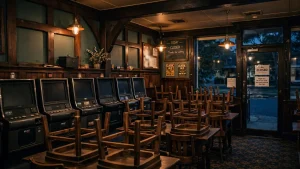
Venue schedules can differ from machine availability, and location listings or online-play claims do not establish what is legally or currently available.
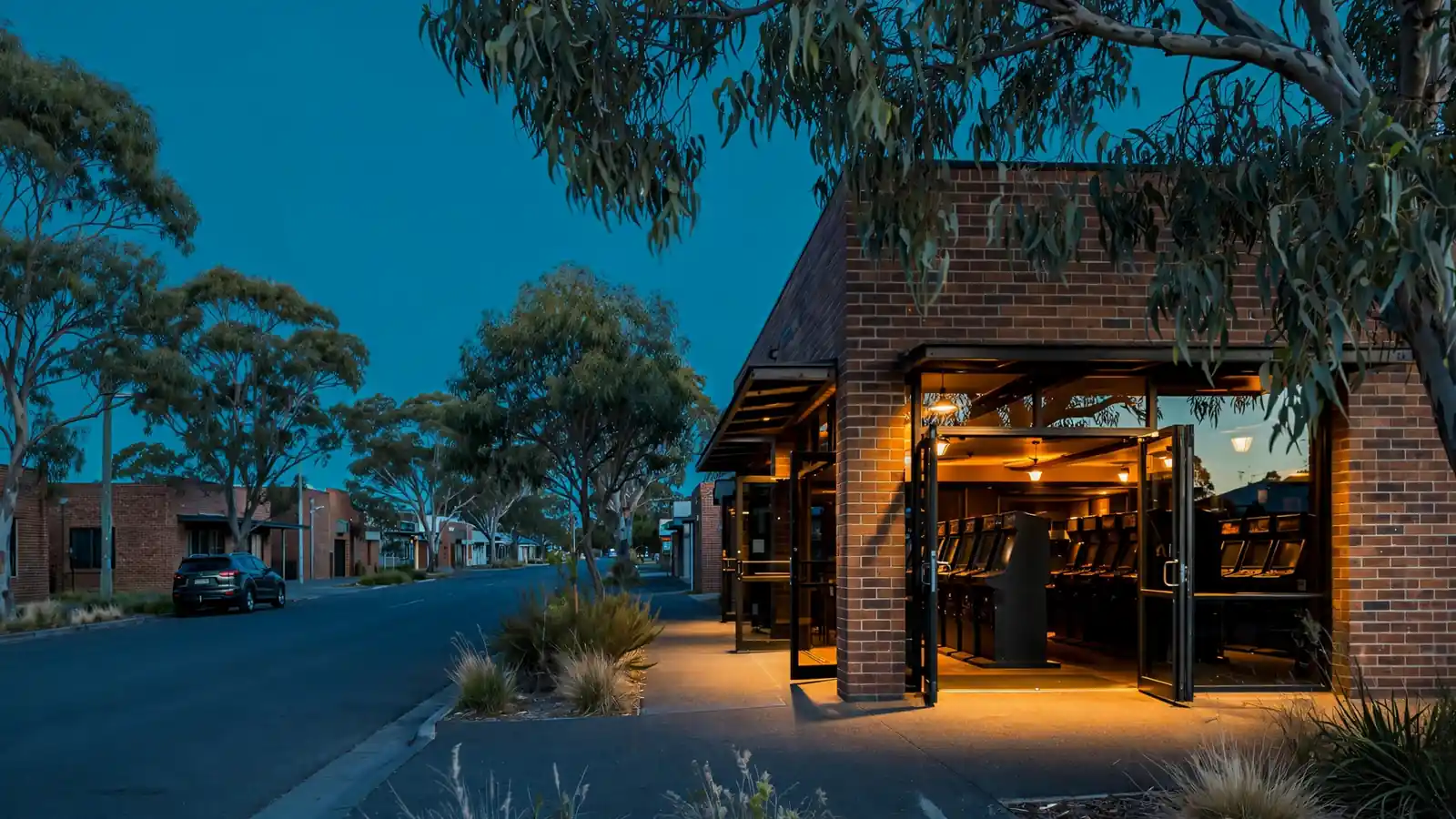
A request for pokies that are open in Tasmania sounds as though it should have a simple answer: a venue, a door, an hour. In practice, “open” can refer to different things. A venue may be open to customers while its gaming machines are not operating, or its usual schedule may not reflect a change on a particular day. A listing that says a place is open is not, by itself, proof that pokies are available at that moment.
That distinction matters for anyone trying to establish whether a Tasmanian venue is open now, early in the morning or late at night. A general search result cannot confirm the live status of a particular room or machine floor. Nor does a broad description of a venue’s usual business establish that its pokies are running. Current venue notices and direct confirmation are more useful for that narrow question than a search result whose status may not reflect conditions on the ground.
This is not a peculiarity of Tasmania. Opening hours describe a schedule; they do not necessarily report what is happening at the instant someone checks. A public holiday, an operational change or a temporary interruption can make a regular schedule a poor guide. No precise early-morning or late-night time should be inferred from the wording of a search alone.
There is also a regulatory condition attached to operating machines at larger venues. A report by regionriverina.com.au describes a requirement taking effect from 1 July: where a venue has more than 20 gaming machines, a dedicated responsible gambling officer, or RGO, must be on duty while those machines are operating. The rule is tied to machine operation, not merely to the venue’s doors being open. It therefore offers useful context for interpreting the word “open”, but it does not reveal whether any particular Tasmanian venue is open or whether its machines are running at a given time.
The RGO requirement puts a human role alongside the machinery. A room can be assessed not only by whether it admits customers, but by the conditions under which gambling takes place. For a venue above the stated machine threshold, the officer’s presence is part of the operating arrangement while the machines are in use. That is a concrete distinction; it is not a timetable.
A search for a named property, including one using the word “Crown”, does not settle the question either. A name in a search phrase is not confirmation that a particular venue in Tasmania exists, offers pokies, or is open at the time being asked about. Venue identity and current operating status are separate matters. Treating the wording as proof would turn a request into evidence.
The same restraint applies to broad phrases such as “pokies open in Tasmania”. They may reflect a wish for an island-wide answer, but operating status belongs to individual venues. Without a current, venue-specific notice, an island-wide statement would flatten differences that matter: whether a place is open, whether its machines are operating, and whether the relevant staffing condition applies. Those are not interchangeable facts.
The rule also should not be stretched beyond its terms. It concerns venues with more than 20 machines and requires the RGO to be on duty while those machines operate. It does not say that every venue has the same opening schedule, that every venue has the same number of machines, or that the presence of an officer proves a venue is open to the public. A staffing requirement is a condition of operation, not a public directory.
So the careful answer to “Are Tasmania’s pokies open now?” is necessarily narrower than the question sounds. The phrase alone cannot verify a live opening status. The most that can be said generally is that larger venues face a specific RGO-on-duty requirement during machine operation, as reported by regionriverina.com.au. Whether that condition applies to a particular venue, and whether its pokies are operating at a particular hour, must be established at venue level.
Hours are not evidence of activity. And a rule is not a timetable.
Choosing pokies in Tasmania means checking the details that matter to you, including licensing and the practical terms available. This list provides a concise starting point for reviewing the operators.
JustCasino
JustCasino is listed with a Curacao Gaming Control Board license.
Neospin
Neospin is listed with a Curacao Gaming Control Board license, number OGL/2023/176/0095, held by Hollycorn N.V.
Thor Casino
Thor Casino is listed with a Curacao license via Antillephone N.V. (Versus Odds B.V.). Its minimum deposit is EUR 20.
MrPacho
MrPacho lists a minimum deposit of A$30. Its stated payout times are 30–120 minutes for crypto and 24–72 hours for fiat.
JeetCity Casino
JeetCity Casino is listed with a Curacao eGaming license held by Dama N.V.
DragonSlots Casino
DragonSlots Casino is listed with a Curacao Gaming Authority license held by Jumpman Gaming Ltd.
Uptown Pokies
Uptown Pokies is listed as operating under a Curacao license since 2017. Its minimum deposit is A$20.
Playfina Casino
Playfina Casino is listed with a Curacao eGaming license held by Hollycorn N.V. and has been operating since 2017. Its minimum deposit is A$20–30, depending on the offer.
Ricky Casino
Ricky Casino lists a minimum deposit of A$20, or A$30 to qualify for the bonus. Its stated payout times are under one hour for crypto and 1–3 business days for PayID.
WinSpirit Casino
WinSpirit Casino is listed with a Curacao eGaming license, number OGL/2024/923/0383, held by Antillephone N.V. Its minimum deposit is A$30.
A return-to-player percentage, or RTP, sounds like a tidy answer to an untidy question: which pokie gives the most back? It is better understood as a theoretical measure of a game’s design than as a forecast for a particular person, session or visit. It cannot tell anyone what the next spin will do, or settle which game will leave a player ahead.
The distinction matters because a percentage can look precise while saying little about an individual result. A return figure describes a model across play, not a promised share of a particular stake returned to a particular player. The real sequence of outcomes may differ sharply from that model. A high stated RTP does not mean that a player is due a win, nor that a game will produce one within a chosen stretch of play.
There is another complication, noted in a specialist review of pokies: some providers allow casinos to choose among different RTP settings for the same game. The title on the screen, then, may not be enough to identify the return setting in force. Two casinos could offer the same pokie while using different settings. That possibility does not establish which setting applies at any particular Tasmanian venue, and it cannot support a ranking of local machines.
Attention: Some providers allow casinos to choose among different RTP settings for the same game, meaning the same title may have different return percentages at different venues.
The name stays the same. The underlying configuration may not.
Even where a return figure is published, it needs to be attached to the right version of the game and the right setting. A number detached from that context can create the appearance of comparison without providing a sound basis for one. Game title alone is not proof that two machines share the same return percentage; nor is the presence of a familiar title evidence that a venue has chosen the setting a player might prefer.
And no RTP setting removes chance from the individual spin. Each spin is generated independently by a Random Number Generator, so an earlier result does not make a particular next result more likely. A run of losses does not build a debt the machine must repay. A run of wins does not establish that the following spin will continue the pattern. The machine has no memory in the human sense, and the player’s sense of a sequence is not a mechanism inside the game.
This is why the phrase “best-paying” needs a narrow reading. It might refer to a published RTP figure, if that figure is current and tied to the exact configuration being played. It cannot responsibly mean “most likely to pay out tonight”, “the one that pays back the most in a short session”, or “the safest choice for a win”. Those are claims about outcomes that an aggregate return percentage cannot make.
The same caution applies to broad claims about the best pokies in Tasmania, whether the setting is a city casino, a CBD venue or somewhere else. Without comparable, current information about each game’s exact RTP setting, a league table would be an arrangement of confidence rather than evidence. A familiar game name, a glowing screen or a story about someone else’s win cannot fill that gap. Stories travel better than statistical qualifications; that does not make them better measures.
A meaningful comparison would need to identify the game and the RTP setting, and distinguish that technical measure from the results any individual may experience. Even then, the comparison would describe game configuration, not promise a personal return. That is a smaller claim than a ranking of “best-paying” machines, but a more honest one.
For anyone considering a session, the practical point is not to treat RTP as a personal forecast or as a reason to chase losses. Deposit limits, loss limits, session time limits and self-exclusion are responsible-gambling tools that address the human side of play; an advertised return percentage does not replace them. A game’s mathematics may be stated with precision. The experience of one person at one machine remains uncertain.
So “best-paying” can describe a comparative setting only when the comparison is properly identified. It cannot name a guaranteed winner, and it cannot turn a random outcome into a schedule. The percentage belongs to the design. The next spin belongs to chance.
A map can make a place look more settled than it is. A label such as “near the airport” seems to promise a useful answer: a venue, a distance, perhaps a short trip between one point and another. But a place name on its own does not establish that a particular venue has pokies, how far away it is, or whether the machines are accessible there. Those are separate claims, and they should not be folded into a pin on a map.
Tasmania’s airport searches have the same difficulty. “Pokies at the airport” and “pokies near the airport” describe different things, yet neither phrase identifies a verified venue or confirms that machines operate inside the terminal. The distinction matters. A nearby place is not an airport facility, and a general search result is not proof of what is available at either one.
The same caution applies to searches for pokies near Tasmania’s CBD. “CBD” can mean a broad central area rather than a precise address; in Tasmania, the word may also leave unclear which town or city is meant. A result associated with a central district does not, by itself, settle the distance from a particular street or confirm that the venue has machines. Location language is often neat. Geography is not.
Nor does adding “north Tasmania” resolve the problem. A regional label can cover a wide area, while “near me” depends on where the person is standing and how a service defines nearby. These phrases are useful starting points for narrowing a map, not reliable descriptions of an individual venue’s facilities. A search result may suggest where to investigate, but it cannot substitute for confirmation from the venue itself.
There is a quieter social detail in these location searches. They treat access as a question of distance: what lies close to an airport, a centre, or a familiar landmark. Yet proximity says nothing about the character of a place or the conditions attached to entry. A pin can show where an address sits; it cannot explain what happens inside. The map is a beginning, not a witness.
Age is one point that does not shift with the map. In Australia, gambling, including playing pokies online, is restricted to people aged 18 or older. That national minimum does not confirm that any particular airport, CBD or regional location has pokies, nor does it describe the access arrangements at a venue. It is a threshold, not a location guide.
So the useful distinction is between finding an area and establishing a fact about a venue. Searches for pokies near Tasmania’s airport, in a CBD, or somewhere in the north can point towards places to check. They cannot alone verify a machine, a distance or an entry arrangement. A place name is not a floor plan.
A venue is more than the room in which pokies sit. It is also a place where responsibility has to be assigned, and where signs of gambling harm cannot be treated as someone else’s business. That distinction matters when a search for a “best” venue turns an institutional question into a popularity contest.
A report by regionriverina.com.au describes a requirement for venues with more than 20 gaming machines to have a dedicated responsible gambling officer (RGO) on duty from 1 July while the machines are operating. The point is not that an officer makes a venue best, or that the presence of one says anything about a machine’s returns. It places a named responsibility inside the venue during the period when its machines are in use.
That arrangement shifts the focus from a general promise of care to a person assigned to the role. The distinction is modest but consequential. In a busy venue, responsibility can otherwise dissolve into the background: a concern noticed by one staff member, a conversation handled by another, a decision nobody quite owns. A dedicated RGO gives that duty a clearer place in the room’s organisation.
The same report describes a requirement for venues to keep a gambling incident register. It is intended to record occurrences, including situations in which a patron’s behaviour indicates they may be at risk of gambling harm or affected by it. The register is an administrative record, not a rating system. It does not establish that one venue is safer, kinder or more suitable than another, and it cannot serve as a league table for Tasmanian pokies venues.
That is worth keeping in view because venue searches often invite a simple verdict: which place is best? A register records relevant incidents; it does not, by itself, reveal how frequently they occur across venues or how each venue responds. Nor does the requirement turn a venue’s public reputation into evidence of its day-to-day practice. A record-keeping obligation is not an award.
The two measures belong together. An RGO is a designated presence while qualifying machines operate; an incident register gives the venue a way to document certain events. One concerns responsibility in the moment, the other the recording of occurrences. Neither substitutes for the other, and neither tells a visitor which room to choose.
This is a less glamorous way to judge a venue than counting machines or relying on a glowing description. It is also more grounded. The rules described in the report concern how venues organise oversight, not which venue has the “best pokies.” That phrase can sound like a verdict on the machines, the atmosphere and the people working there all at once. The records cannot support such a verdict. They can, however, show what duties a venue is expected to take seriously. A narrow measure. Still a measure.
A question about pokies aboard the Spirit of Tasmania belongs first to the world of travel: it asks what is available on a particular ship. It does not establish that gaming machines are on board, any more than a search combining Tasmania with the name Crown establishes a Tasmanian casino or confirms what machines a venue might have. Those are claims about actual places and facilities, not conclusions that can be drawn from the wording of a question.
Legal Risk
The Interactive Gambling Act 2001 prohibits companies from providing real-money online pokies to people in Australia without a domestic licence.
Online play is a different subject. A request for a no-deposit offer, or for real-money pokies from Tasmania, moves from transport and venues to the legal treatment of internet gambling. The distinction matters because a physical pokie and a game offered through a website do not sit under the same practical arrangement. A ferry’s facilities, if any, say nothing about the legality of an online operator; nor does a place-name attached to an online offer turn it into a local service.
The governing law is the Interactive Gambling Act 2001. It prohibits companies from providing real-money online pokies to people in Australia without a domestic licence. No domestic licences for that service have been issued. The prohibition is directed at operators rather than individual players: Australian residents are not the party the law targets, and they may play on offshore sites that accept them. That distinction is not an endorsement of those sites, or evidence that an Australian-regulated online casino exists.
There is a further complication between legal responsibility and practical access. Offshore gambling sites can be subject to blocking in Australia, and access may be disrupted. A site that remains reachable, or accepts a resident’s account, does not thereby acquire Australian authorisation. Nor does a welcome offer change the legal status of the service. A bonus is a commercial inducement, not a licence.
The law’s asymmetry can seem odd at first: the operator faces the prohibition, while the player is not treated as its target. But the difference reflects where the legislation places responsibility for supplying a service. It does not erase the risks of dealing with an offshore business, and it does not create an Australian body to supervise its online pokies. The word “legal” needs a subject. The operator and the player are not interchangeable ones.
So a question about the Spirit of Tasmania should not be answered with assumptions about online access, and an online offer should not be mistaken for a shipboard amenity or a local casino product. The rules draw a boundary around who may provide real-money online pokies to people in Australia; they do not certify every offshore site that may be encountered. A narrow distinction, with wide consequences.
A venue’s advertised opening hours and the hours when its pokies are operating are not necessarily the same thing. The distinction matters in searches for all-night access: a door may be open for one purpose while gaming machines are unavailable, or a venue may close before the day has turned. Without a current schedule for a particular venue, a claim of round-the-clock play would be guesswork dressed as local knowledge.
“Open now” is especially fragile information. It depends on the venue, the day and any change to its routine, none of which can be inferred from the broad fact that a place has pokies. A search result can preserve an old listing long after a business has changed its hours. The word “open” is not a timetable.
There is also a staffing condition behind machine operation. A report by regionriverina.com.au says that, from 1 July, venues with more than 20 gaming machines are required to have a dedicated responsible gambling officer (RGO) present while those machines are running. The requirement attaches to the period of operation, not simply to the venue’s general opening hours. The room and the machines may therefore have different schedules, even when both belong to the same business.
That is a small distinction with a human purpose. A venue’s hours are often treated as a matter of convenience, as though access were only a question of whether the lights are on. The RGO requirement instead places a person alongside the machines during the hours they operate. The rule makes staffing part of the operating context, rather than an invisible detail behind the floor.
The same report describes a one-month grace period for venues to bring in responsible gambling officers and remove signage. That transition period concerns the changes around the requirement; it does not establish when any Tasmanian venue opens, closes or switches its machines on. Nor does it turn a venue listing into proof of continuous availability.
For anyone comparing opening times, the useful distinction is between a venue being open and pokies being available there at that moment. One does not certify the other. A published schedule may help with the first; machine operation has its own conditions. And a general label such as “24-hour” should not be mistaken for a promise that gaming continues without interruption.
The practical picture is less dramatic than the search phrase. Tasmania has venues with their own operating arrangements, while rules governing machine operation can also require a responsible gambling officer to be on duty. Neither point supplies a universal clock for the island. Hours remain local. So does the answer.
Pokies invite the eye to make a story out of movement: symbols arrive, pause, and line up in patterns that seem to ask for interpretation. Across Tasmania, the same human habit follows machines from one setting to another. A run of near misses can feel like a sign; a recent win can make the next spin seem charged with possibility. Neither feeling changes how the next result is produced.
A Random Number Generator determines the outcome of each spin. Each spin is separate from the one before it, rather than a step in a sequence that is trying to correct itself. A losing streak does not make a win due, and a win does not make another win more likely. The machine carries no memory in the sense that matters to the next result.
That independence is easy to accept in the abstract and harder to feel while watching a screen. Human beings are pattern-finders by trade: repetition looks meaningful, and coincidence acquires a plot almost as soon as it happens. Pokies make that instinct especially visible. The symbols are familiar, the pauses are theatrical, and the result appears as a small event with a beginning and an end. The mathematics does not share the drama.
Words such as “best” can also blur two different ideas. A game someone likes, or a machine that has recently paid out, is not thereby a forecast of what it will do next. Nor does calling a machine a maximum-bet pokie establish what a particular spin will return. Those descriptions do not turn independent outcomes into a dependable pattern.
The same caution applies to talk of a maximum cash payout. A stated limit, where one is available, would describe a boundary rather than predict that it will be reached on any given spin. They do establish the narrower point: one outcome cannot be read as a promise about the next.
This is why a list of “best pokies in Tasmania” cannot be justified by recent results alone. A short run of outcomes may be memorable, but it cannot show what the next independent draw will produce. Ranking machines by stories about streaks would turn coincidence into evidence. It is a tempting shortcut. Still a shortcut.
The practical distinction is modest but important: an outcome can be observed after a spin; it cannot be used to forecast the next one. Each time, the generator determines a fresh result. Patterns may decorate the experience, but they do not make it predictable.
A search for online pokies in Tasmania can make the activity seem like a local version of a casino visit: the same language, moved onto a screen. Legally, the distinction is sharper. There is no Australian-licensed online casino. The Interactive Gambling Act 2001 prohibits operators from providing real-money online casino games, including pokies, to people in Australia.
That prohibition is directed at the businesses supplying the service, not at individual players. Australians are not fined or prosecuted merely for playing on an offshore site that accepts them. But the absence of player liability should not be mistaken for a local system of protection. A service can be accessible without being licensed here, and an offshore licence does not turn it into an Australian-regulated casino.
The practical risk becomes clearest when money is disputed. If an offshore operator refuses to pay winnings, a player has no legal recourse in Australia to compel payment. The promise on a screen may be easy to make; enforcing it across borders is another matter. A local casino licence does not exist to stand behind that transaction.
This is why “online pokies near Tasmania” is an awkward idea. A website may be reachable from the state, but it is not a venue nearby, subject to Australian casino licensing. Nor does a site’s willingness to accept Australian customers establish that its games or payment arrangements are overseen by an Australian regulator. Geography on a screen is a thin substitute for jurisdiction.
Tasmania’s physical venues and offshore websites therefore belong to different legal worlds. The first are places whose operation sits within local rules. The second are services the Commonwealth law bars operators from supplying to Australians, even though players themselves are not the target of that prohibition. The gap is not merely technical. It determines what protection exists when the relationship breaks down.
The same caution applies to claims about high-limit play or the best-paying pokies available online. Such language can imply that a local authority has assessed the offer or that a dependable remedy exists if its terms are not honoured. Neither follows from the fact that a website opens on a device in Tasmania.
The Australian position is unusually stark: no domestic online casino licence, a ban on operators providing real-money casino games here, and no Australian legal route for recovering winnings withheld by an offshore site. Access and protection are not the same thing.
A club in a central business district can sound like a precise answer to a broad question about Tasmanian pokies. The label narrows the map, but it says little about what machines are available, how a venue manages gambling harm or whether its policies differ from those of another club. A postcode is not a quality measure.
That distinction matters when “best” is attached to a place. A venue-level claim would need evidence about the venue itself; a claim about a particular pokie would need evidence about that machine. Neither follows from a club’s name, its location or the general fact that clubs may have gaming machines. No ranking can responsibly be built out of those associations alone.
There is a more useful way to think about club oversight: what happens when gambling causes concern. A report by regionriverina.com.au describes a requirement for venues with more than 20 gaming machines to keep a gambling incident register. The register is intended to capture relevant occurrences, including a patron showing signs of being at risk of, or affected by, gambling harm. This is an account of a reporting requirement, not evidence that any particular Tasmanian club has handled an incident well.
Records matter because the public face of a venue is rarely the whole story. A machine floor can look orderly while the less visible work involves noticing patterns of distress, recording an occurrence and responding through the venue’s procedures. That is why a register is an oversight tool, not a rating. Its existence cannot show that one club is safer, more attentive or more suitable than another.
The same care applies to searches that combine “CBD”, “club” and “pokies”. Those words point toward a type of place, not a confirmed list of venues or a comparison of their machines. Nor does a general reference to self-exclusion establish how a particular club administers it. Venue-specific claims need venue-specific evidence.
The language of “best” is attractive because it turns a complicated question into a neat verdict. But for clubs, machine availability, local procedures and responses to harm are separate matters. A location can be identified on a map; its standards cannot be read from the map. Plainly different things.
“Cashless” can describe a way of handling money at a venue, but it does not identify how a particular pokie accepts payment. A search for cashless pokies in Tasmania may therefore bring together two separate questions: how money moves between a bank account and another service, and how a venue’s machines are configured. One answer cannot stand in for the other.
PayID belongs to the first category. It is an alias layer built on the New Payments Platform, allowing a transfer to be addressed through an email address, mobile number or ABN. It is a way to direct a bank transfer, not a label for a pokie’s payment equipment. Its existence says nothing about whether a Tasmanian venue uses cashless machines, or what payment arrangements operate there.
The distinction matters because the same word can make different systems appear interchangeable. A bank transfer made through PayID is not, by that fact alone, a cashless play system inside a club or hotel. Nor does a venue’s cashless arrangement establish anything about PayID. They sit at different points in the movement of money.
That separation also prevents a broader misunderstanding. Where PayID is linked to a bank account for real-money online casino play, the payment method does not establish that the service is licensed, that its games are fair, or that its return percentages are disclosed. Payment plumbing is not a seal of approval.
The location attached to a request for “the best pokies” around Newcastle, Tasmania, changes none of this. A place name cannot verify a machine’s payment setup, just as PayID cannot identify a venue or rank its pokies. Those are distinct claims, and each requires its own evidence.
The useful distinction is plain: PayID describes a transfer route; cashless play describes an arrangement for using money at a machine or venue. Confusing them turns a technical convenience into a claim it cannot support. No magic in the alias.
Yes, Australians can legally play on offshore sites that accept them, but no Australian-licensed online casino exists. The law targets operators offering real-money pokies without a domestic licence, and players have no legal recourse in Australia if an offshore casino refuses to pay.
Each spin is an independent random event determined by a Random Number Generator. The same game may also have different RTP settings at different casinos.
Yes. PayID is treated like any other qualifying deposit method at the recommended sites.
You must be 18 or older to gamble online in Australia.